Natural Wonders in Iceland
Updated · BootsnAll
 Iceland gets called the land of fire and ice, and after a few days of driving you'll see why. It's also a land of waterfalls, geysers, black sand, midnight sun and swirling Northern Lights, of hot springs and blue lagoons, and of shaggy little horses and maybe even elves.
The best part is how close together it all sits. On a single day out of Reykjavik you can stand in a rift valley, watch a geyser go off and get soaked by a waterfall. Here's what to look for, and what has changed since I first wrote this page in 2010.
Volcanoes
Iceland sits on the Mid-Atlantic Ridge, right over a volcanic hotspot, so the island is still being built. The Catalogue of Icelandic Volcanoes, an official publication of the Icelandic Met Office, the University of Iceland and Civil Protection, covers 33 active volcanic systems. Hekla is the famous one, and its last eruption was in 2000.
When this page first went up, Eyjafjallajökull was the big news: it erupted in spring 2010 and its ash cloud shut down air travel across Europe. It turned out to be the start of a busy stretch. Grímsvötn erupted in 2011, Bárðarbunga fed the huge Holuhraun lava field in 2014 and 2015, and Fagradalsfjall on the Reykjanes peninsula erupted in 2021, 2022 and 2023.
Then the Sundhnúkur crater row next to Grindavík woke up. There were nine eruptions between December 2023 and August 2025, and the last one ended on 5 August 2025. The town was evacuated, lava destroyed houses, and in November 2024 lava covered the Blue Lagoon's car park. Magma has kept building up under the area since, and the Icelandic Met Office says the most likely next step is another magma intrusion, which could lead to an eruption with little warning. If your plans touch Grindavík, the Blue Lagoon or anywhere near Keflavík airport, check safetravel.is and the Met Office before you go. Never walk onto an eruption site that has been closed.
The volcanoes also made the black sand beaches along the south coast near Vik, and the lava tubes that riddle the country.
>> more on volcanoes in Iceland
Waterfalls
You can hardly drive more than a few miles without seeing a waterfall in the distance. These are the ones people plan days around.
- Gullfoss, on the Golden Circle, drops in two steps of 11 and 21 metres into the Hvítá canyon. Look for the memorial stone to Sigríður Tómasdóttir, the farmer's daughter credited with saving the falls from a hydropower scheme.
- Seljalandsfoss, on the south coast, is taller at about 60 metres. It's less of a thunderclap than Gullfoss, but a path runs behind the curtain of water. Bring a rain jacket, because you will get wet.
- Dettifoss, in the north near Lake Myvatn, is 44 to 45 metres high and about 100 metres wide, and the national park calls it the most powerful waterfall in Europe. Put your palm on the rock nearby and you can feel it shake. Paved road 862 reaches the west side. Gravel road 864 on the east side closes when the autumn snow comes.
- Godafoss sits right on the Ring Road between Akureyri and Myvatn, so it's the easiest big northern waterfall to fit in.
Geysers and geothermal areas
The original Geysir, which gave every other geyser its name, rarely erupts now. Its neighbour Strokkur makes up for it, going off every 10 minutes or so, and the Nature Conservation Agency says its eruptions can reach 30 metres. Stand upwind. For steaming vents and bubbling mud without the Golden Circle crowds, try the Hengill area near Hveragerði, or the fields around Myvatn in the north. Then go soak in one of the hot springs and pools the same heat supplies.
Glaciers
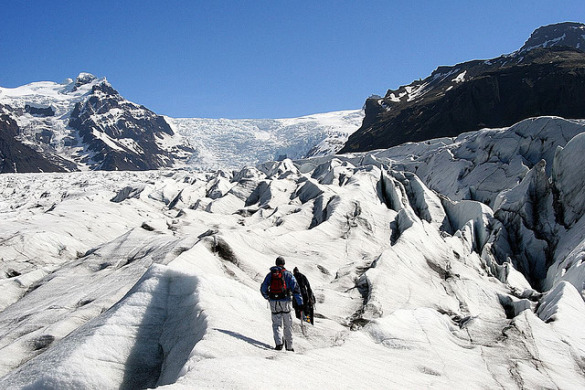
Glaciers cover around 10% of Iceland, and every one of them is shrinking. The Icelandic Institute of Natural History says the retreat has been very fast since 1995. Vatnajökull is by far the largest, at around 7,600 square kilometres in 2023.
The easiest place to see the ice up close is Jökulsárlón, the glacier lagoon on the south coast where icebergs break off Breiðamerkurjökull and drift out to sea. Chunks of ice wash up on the black beach across the road, which everyone now calls Diamond Beach. The lagoon is inside Vatnajökull National Park, a UNESCO World Heritage Site since 2019.
Don't walk on a glacier without a licensed guide. Crevasses hide under snow, and the guide brings crampons, helmets and ice axes and knows where the ice is safe. See outdoor activities and tours in Iceland for glacier walks.
Northern Lights
One of Iceland's most beautiful sights can be its most elusive. You need dark, at least partly clear skies and some solar activity, so forget June and July, when it barely gets dark. The Icelandic Met Office publishes an aurora forecast with cloud cover maps and a 0 to 9 activity scale, plus sunset and darkness times for Reykjavik. Look for clear patches on the cloud map first, then drive away from town lights. Sightings are never guaranteed, even on a good night. More in viewing the Northern Lights.
The midnight sun
The flip side of the dark winters is summer light. Around the June solstice the sun only dips below the horizon for a short while in Reykjavik, and it doesn't get properly dark at all. It's disorienting in a good way: you can start a hike at 9pm. Read experiencing the midnight sun, and pack an eye mask.
Staying safe around all of it
- At Reynisfjara, near Vik, sneaker waves have killed several visitors, most recently a nine-year-old girl in August 2025. Stay well back from the water and obey the warning lights.
- Check safetravel.is for alerts and vedur.is for the weather before every drive. The weather changes fast.
- Many roads to the best sights are gravel or seasonal. Read driving in Iceland before you pick up a rental car.
For how to string these into a trip, see 10 days in Iceland or driving the Ring Road.
Photo by Zanthia