Viewing the Northern Lights in Iceland
· Updated · BootsnAll
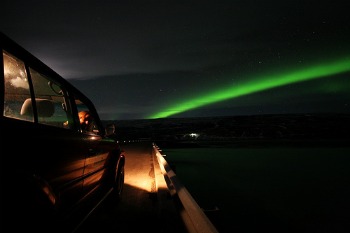 The aurora borealis, or northern lights, those elusive ribbons of light that move across the night sky, can be seen in Iceland from roughly September to mid-April, if you're lucky. You could spend several nights in mid-winter and not see them once, or you could plan a quick stopover in Iceland at the tail end of the season and get an unforgettable show. It can be a crap shoot.
You can shift the odds, though. Here's what I've learned about when to look, where to go, and whether a tour is worth the money.
What the northern lights are
According to NOAA's Space Weather Prediction Center, the aurora is the result of electrons colliding with the upper atmosphere. The electrons are accelerated in Earth's magnetosphere and follow the magnetic field lines down toward the poles, where they hit oxygen and nitrogen and make them glow. It happens between 80 and 500 km up.
In Iceland the most common color is green. Red or purple shows up more rarely. Some displays last for hours. Most come and go in a few minutes, streaking across the sky in ribbons or rippling overhead like curtains. On a faint night they can look like a greyish cloud to the naked eye and only show up as green on a camera.
When to look
The season
You need darkness, which Iceland doesn't have in summer. Tour companies set their seasons accordingly: Reykjavik Excursions runs its northern lights tour from September to mid-April, and Elding's northern lights cruise runs from September 1 to April 15.
Within that window, every month has its trade-offs:
- September and October are milder, so waiting outside is less painful, and the roads are usually clear. See Iceland in September and Iceland in October.
- November to February have the longest nights, and around the winter solstice Reykjavik gets only about four hours of daylight. They also have the worst weather. See Iceland in winter.
- March is still dark enough, with a bit more daylight for sightseeing. See Iceland in March.
The night
Cold, clear, cloudless nights give you the best chance. Clouds are the biggest problem in Iceland, not a lack of aurora. Visit Reykjavik lists cloud cover, moonlight and city light pollution as the things that decide what you'll see, so a clear night around the new moon is ideal. Late evening into the early hours is the usual time to be out.
How to read the forecast
The Icelandic Met Office aurora forecast is the one to check. It shows two things:
- A cloud cover map. Green areas are cloudy and white areas are clear, which catches people out. You can slide forward through the next few days.
- An activity number from 0 to 9 in the corner, forecasting aurora activity at midnight.
Look at the clouds first. A moderate activity number under clear skies beats a high number under thick cloud every time. The page also shows sunset and darkness times for Reykjavik. For a short-term view of what the aurora is doing right now, NOAA publishes a 30-minute aurora forecast.
My habit: check the Met Office forecast in the afternoon, pick the clearest area within reasonable driving distance, and decide by dinner.
Where to watch
In Reykjavik
It is sometimes possible to see the northern lights from Reykjavik, but only when they're strong. Street lights wash out fainter displays. Visit Reykjavik suggests heading for the sea or outside the city center. The easiest spot is Grótta, the lighthouse at the tip of the Seltjarnarnes peninsula, west of downtown. It faces open sea to the north and west, with much less light around it.
Outside the city
Even 30-45 minutes out of town makes a big difference. A lot of people drive to Þingvellir National Park to sit and watch. Anywhere in the countryside works if the sky is clear, so if you're staying outside the city, just keep an eye on the sky. Cloud cover can vary a lot across the country on the same night, and the forecast map shows you where the gaps are. That's one reason to spend a few nights somewhere like Akureyri or Mývatn.
If you drive yourself, check umferdin.is for road conditions first, and never stop on the road itself to look up. Pull into a proper parking area. Safetravel has more on winter driving, and so does our page on driving in Iceland.
Tour or do it yourself?
There are dozens of tour companies all over Iceland that will take you on a northern lights tour. Some are big coaches, some are smaller groups, and Elding goes out by boat from Reykjavik's Old Harbour. The upside is that someone else does the winter driving, and the guide knows where the clear patches are. You'll also learn a lot more about what you're looking at.
The downside, aside from the cost, is that nothing is guaranteed. Policies vary, so read them before you book. Reykjavik Excursions, for example, cancels with a refund or rebooking if the conditions look bad, and if the tour runs and the lights don't show, it lets you rebook free of charge as many times as you need, with the rebooking valid for two years. Without a policy like that, you've paid for a long evening bus ride with a lot of strangers, who also cut into the romance.
My strategy: go without expectations. If you're in Reykjavik, watch the forecast, and when there's a good chance, grab your rental car and go, or book a last-minute spot on a tour. Book a tour early in your trip so you have nights left to use a free rebooking.
If the clouds never clear, Aurora Reykjavík, a small northern lights center at Fiskislóð 53 in the Grandi harbor area, is open 10am to 7pm daily. Adult entry is 3,900 ISK.
Photographing the aurora
- Use a tripod or prop your camera on something solid. Exposures run several seconds.
- Most recent phones have a night mode that picks up color your eyes can't see. Hold still, or lean the phone against something.
- Turn off the flash, and put your screen brightness down so you keep your night vision.
- Bring spare batteries and keep them in an inside pocket. Cold drains them fast.
- Include something in the foreground, like a mountain, a church or the lighthouse, so the photo has a sense of place.
My best sighting
You might luck out like I did. I stepped out of my rental cabin in Húsavík expecting to see a few stars, and instead saw the northern lights overhead. I hadn't checked a forecast or booked anything. You can stack the odds, but some of it is luck.
FAQ
What is the best month to see the northern lights in Iceland?
There's no single best month. Anything from late September to March works if the sky is clear. Dark nights and dry, settled weather matter more than the calendar, so give yourself as many nights as you can.
Can you see the northern lights in summer?
No. From May to July the sky in Iceland doesn't get dark enough. Tour seasons start in September for that reason.
How many nights do I need?
The more the better. Three or four nights give you a much better chance of at least one clear break than a single night does. Even then, a week of cloud can happen, so treat a sighting as a bonus rather than the whole point of the trip.
Do I need a tour?
Not if you're comfortable driving on winter roads and willing to check the forecast yourself. A tour makes sense if you don't want to drive in the dark, or if the free rebooking policy lets you try several times.
Photo by Tom Olliver