Driving in Iceland
· Updated · BootsnAll
 Driving in Iceland can feel daunting. The Ring Road is paved all the way around now, but once you leave it (and you should) you'll meet gravel, blind hills, one-lane bridges, sheep, flooded tracks and potholes. And that's in summer. Even so, plenty of visitors drive themselves around the country every year without trouble. The ones who get into trouble usually ignored one of the basics below.
Licenses and rental rules
Your home license is generally fine. Rental companies such as Hertz Iceland accept a license printed in the Latin alphabet that you've held for at least 12 months; if yours uses another script, bring an International Driving Permit.
The minimum rental age is lower than I wrote in 2010. At Hertz, most cars need a driver aged 20 or older, and larger SUVs, vans and luxury cars need 23 to 25. Other companies set their own limits. More on choosing a car in car rental in Iceland.
The rules of the road
These come from Safetravel, Iceland's travel safety site:
- Drive on the right.
- Speed limits: 50 km/h in towns, 80 km/h on rural gravel roads, 90 km/h on rural paved roads, and 50 km/h on single-lane bridges.
- Headlights and taillights on at all times, all year. The automatic light setting isn't enough.
- Everyone wears a seatbelt, front and back. Children under 135 cm need a car seat.
- No phone or tablet use while driving.
- The blood alcohol limit is 0.2‰, which in practice means not even one drink.
- Off-road driving is strictly forbidden. Stay on marked roads and tracks, F-roads included.
- Don't stop on the road or its shoulder for photos. Find a proper pull-off.
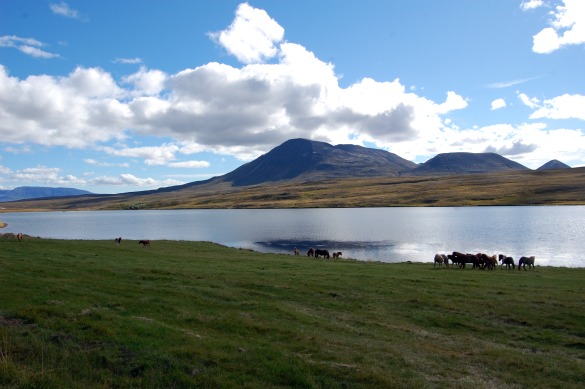
Watch for livestock. Sheep, horses and cows wander onto roads, and if you hit one you may be liable to the farmer for the damage. In roundabouts, the car in the inner lane has right of way when it exits, which catches a lot of visitors out.
Tips for safe driving
- Slow down where pavement turns to gravel. It's where many drivers lose control.
- Slow down and move right when you meet another car on a narrow or gravel road.
- At blind hills, slow down and keep right; you can't see what's coming over the top.
- At a single-lane bridge, whoever reaches it first goes first. Stop and wait if the other car is closer.
- Check the weather and road conditions every morning, and again during the day in winter. Wind is the one people underestimate. Hold the door with both hands when you open it.
- Don't drive tired. Many visitors land after an overnight flight and set off straight away. Safetravel's advice is to swap drivers or stop for 15 minutes.
- Top off your tank whenever you can outside the Reykjavik area, and carry a map in case you lose signal.
Where to check conditions
- umferdin.is: the Road and Coastal Administration's live map of road conditions and closures. Its traffic line is 1777.
- safetravel.is: alerts, including volcanic activity near Grindavík on the Reykjanes peninsula, which erupted nine times between December 2023 and August 2025 and can close roads around the Blue Lagoon at short notice. The Icelandic Met Office posts the current status.
- vedur.is: the Icelandic Met Office forecast and warnings.
A road marked Lokað is closed. Closures only happen when they're needed for safety, so don't drive around the barrier.
Highland driving
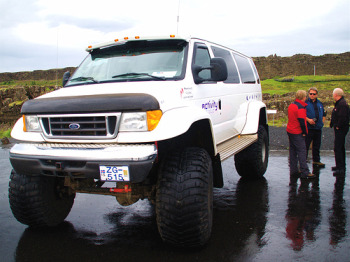 The interior is reached by mountain roads marked with an F before the number. They need a 4x4, and not every 4x4 suits every F-road. Some routes are fine in a small SUV; others need a Land Cruiser or a modified super jeep.
- F-roads usually close from mid-September until June or July, depending on snow. Check umferdin.is before you plan a route.
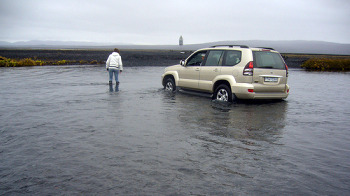
- Many rivers have no bridge. No insurance covers damage from crossing a river. If you're not sure, don't cross. If you do, go slowly in low gear and don't change gear midstream.
- All highland roads are loose gravel. Keep your speed down, especially on bends and when you meet another car, and don't slam on the brakes.
- Read your rental contract. Some cars aren't allowed on F-roads at all, and you're on the hook for anything that happens there.
Before a highland trip, talk to rangers, hut wardens or the local information center. More in the Highlands.
Winter driving
Winter conditions can turn up in spring and autumn as well as winter. Expect ice, blowing snow, short days and closures on mountain passes. Studded tyres are allowed from 1 November to 15 April, and winter tyres need at least 3 mm of tread, according to Reykjavík City. If you rent in winter, ask what tyres the car has. Safetravel has an online driver's test worth ten minutes of your time before you go. If you're not used to icy roads, base yourself in Reykjavik and use day tours, or keep to the south coast.
Campervans and where you can sleep
When I first wrote this page, lots of people toured in a campervan and parked wherever they liked. You can't do that now. Under the Nature Conservation Act, spending the night in a campervan, caravan, tent trailer or similar outside an organised campsite or town is illegal without the landowner's permission. Many popular spots, Dynjandi and Dimmuborgir among them, ban overnight stays outright. Plan your nights around campsites.
Emergencies
Call 112 for police, ambulance, fire and rescue anywhere in Iceland. For non-urgent medical advice, the health service's round-the-clock line is 1700 (or 513 1700), not the 1770 number I listed in 2010.
FAQ
What does it cost to drive in Iceland in 2026?
Budget for fuel (petrol was about 235 to 270 ISK a liter at most stations in September 2026, per Gasvaktin) and the new kilometer fee of 6.95 ISK per km, in force since 1 January 2026. Rental companies add that fee to your bill. If you bring your own car on the ferry, it pays too: for a stay of 30 days or less, a car up to 3.5 tonnes pays a fixed fee of 13,900 ISK (10 days or less), 20,850 ISK (11 to 20 days) or 24,325 ISK (21 days or more), and Iceland Revenue and Customs sends payment instructions to whoever booked the car's crossing, according to island.is.
Is it safe to drive the Ring Road in winter?
It can be, with the right car, flexible dates and daily checks of the forecast. Read driving Iceland's Ring Road and Iceland in winter first.
Can I drive to the Northern Lights myself?
Yes, but pull fully off the road to watch, and never stop on the road itself. Þingvellir is a popular spot close to Reykjavik. See viewing the Northern Lights.
Photos by Eetu Immomen, wili hybrid