Hot Springs and Swimming Pools
Updated · BootsnAll
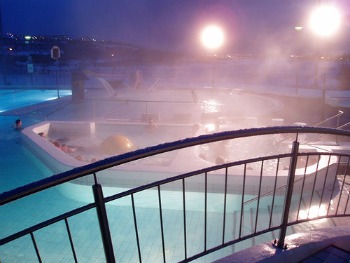 Iceland runs on the heat under its feet. Almost all of the country's electricity comes from renewables, about 70% hydro and 30% geothermal, and the geothermal plants and boreholes produce far more hot water than anyone could shower in. Icelanders put the extra to good use: heated homes and a hot pool in nearly every town.
Soaking is the national pastime. In December 2025 UNESCO added Icelandic swimming pool culture to its list of Intangible Cultural Heritage, the country's first solo nomination. If you only pick up one local habit on your trip, make it this one.
Three kinds of hot water
When people say "hot springs" in Iceland, they usually mean one of three things:
- Town swimming pools. Cheap, everywhere, full of locals. Most have an outdoor pool plus a row of hot tubs (heitir pottar) at different temperatures.
- Geothermal lagoons and baths. Man-made pools designed to look natural, with bars, saunas and higher prices. The Blue Lagoon was the first famous one, and newer lagoons have opened in every region since.
- Natural hot springs. Rivers and pools you hike to, like the hot river in the hills above Hveragerði. See hiking in the Hengill geothermal area. Temperatures vary and some springs are scalding, so stick to places where people bathe and read the signs.
Pools in Reykjavík
Most visitors' first soak is in the capital, and the city pools are where you'll see how Icelanders actually use them: chatting in the hot tub before work, kids everywhere on weekends. Entry costs a fraction of a lagoon ticket. I've written them up in Reykjavík city pools and hot spring pools in and around Reykjavík.
The lagoons, region by region
Prices below are adult entry as listed on each operator's site in 2026. Most use timed booking, so book ahead in summer.
Around Reykjavík and Reykjanes
Blue Lagoon, near Grindavík, is still the big one, with tickets from 11,990 ISK and advance booking required. It's open every day, with building work under way through 2027. It sits in the middle of the Reykjanes eruption zone. The Sundhnúkur craters erupted nine times between December 2023 and August 2025, the lagoon closed during several of those eruptions, and in November 2024 lava covered the lagoon's car park. The Icelandic Met Office says magma is still building up, so check safetravel.is and the Met Office before you go.
Sky Lagoon opened in 2021 on the Kársnes waterfront in Kópavogur, a short ride from downtown. It has an infinity edge facing the ocean and a seven-step ritual that takes you through a sauna, a cold mist, a steam room and a body scrub. Entry with the ritual starts at 14,990 ISK for the Saman pass (shared changing room) and 17,990 ISK for Sér (private changing room). Opening hours change with the season: 10:00-21:00 from 21 October to 30 April, 10:00-22:00 from 1 May to 20 June, 8:00-23:00 from 21 June to 20 August, and 9:00-22:00 from 21 August to 20 October. It's the easy pick if you don't have a car or don't want to drive toward the volcano.
Golden Circle and the south
Secret Lagoon (Gamla laugin) in Flúðir is the oldest swimming pool in Iceland, built in 1891 beside a hot spring area. It sat abandoned for decades and reopened in 2014. It's simpler and cheaper than the big lagoons: 4,500 ISK. It fits well into a day on the Golden Circle.
West Iceland
Krauma sits beside the Deildartunguhver hot spring, near Reykholt, about 97 km from Reykjavík. It's a good stop on the way to or from the Snæfellsnes peninsula or the north.
North Iceland
Earth Lagoon Mývatn is the new name for the Mývatn Nature Baths, which I wrote about here. The baths have been running since 2004, and a rebuilt facility opened in summer 2026. Entry starts at 7,900 ISK, and it's open 12:00-22:00. It's 89 km from Akureyri, so pair it with a day around Lake Mývatn.
Forest Lagoon is in the woods at Vaðlaskógur, 3.6 km from central Akureyri. It opened in May 2022. The basic "Warm" ticket is 7,490 ISK, and it's open every day until midnight (out of the water by 23:30). Towels cost 1,400 ISK extra, and it only takes Icelandic krónur.
GeoSea in Húsavík, open since 2018, fills its pools with geothermally heated seawater at 38-39°C. It's on the cliffs above Skjálfandi bay, the same bay the Húsavík whale-watching boats head into. For something cheaper, the hot tubs on the black sand beach at Hauganes cost 1,000 ISK, and Grettislaug at Reykir is a pair of pools named for the saga hero Grettir the Strong. More in my North Iceland guide.
East Iceland
Vök Baths sit on the shore of Lake Urriðavatn, a few minutes from Egilsstaðir, and have been open since summer 2019. The pools float out on the lake itself. Entry starts at 7,690 ISK, and hours are 12:00-22:00. It's the obvious stop if you're driving the Ring Road through the east.
Pool rules and etiquette
Hot springs and public pools come with a set of rules, and staff will call you out if you skip them. Here's what you need to know.
- Shoes off before the locker room. Leave them on the rack outside the door. Wearing shoes inside is bad manners.
- Shower naked, with soap, before you get in. Icelandic pools use less chlorine than you may be used to, so everyone washes properly first. You'll see signs showing the areas to pay special attention to, and at some pools an attendant makes sure you do it.
- Yes, in front of strangers. The Blue Lagoon has private shower stalls, but many town pools have one open room with a row of shower heads. If you're nervous, know that the other tourists are too busy trying not to be seen to notice you, and the locals don't care.
- Bring your own gear to small pools. In Reykjavík and at the lagoons, staff speak English and you can rent a towel and swimsuit. In rural towns you may need your own, and some small pools have hooks instead of lockers, so leave valuables in the car or at home.
- Condition your hair at the mineral lagoons. At the Blue Lagoon and similar silica-rich water, coat your hair in conditioner before you go in, or keep it out of the water. The minerals leave it stiff for days.
- Dry off before you go back inside. Wet footprints on the locker room floor will earn you a look. Most places have hair dryers if you're heading straight out.
For what to pack, see packing for Iceland.
FAQ
Which lagoon should I pick?
If you have one evening in Reykjavík and no car, Sky Lagoon. If you're flying in or out and there's no volcanic activity, the Blue Lagoon is near the airport. If you're heading north, Forest Lagoon and Earth Lagoon Mývatn are cheaper and much less crowded. And if you want what locals do, go to a city pool.
Do I need to book?
For the Blue Lagoon, yes: it requires advance booking. The other lagoons sell timed tickets online and can sell out on summer evenings, so booking is smart. Town pools are walk-in.
Can I wear a swimsuit in the shower?
No. The rule is to wash without it before you put it on. Most places with private stalls let you close a door, but the swimsuit still goes on after.
Are hot springs safe in winter?
The pools and lagoons are open year-round and soaking in the snow is one of the best things about an Iceland winter. Natural springs in the hills are another matter: check safetravel.is and the weather before hiking to one.
Photo by blue eyes