Map of Iceland
Updated · BootsnAll
Iceland is a small country and an easy one to find your way around. It covers about 103,000 square kilometers (roughly 40,000 square miles), a little smaller than Kentucky, and one main road, Route 1, the Ring Road, loops all the way around it. Directions from town to town are often a single sentence: follow the road until you get there. Signs along the way tell you which town is next and how many kilometers off it is. You can still take a wrong turn, but it's hard to get truly lost.
Google map of Iceland
Zoom in to find towns, fjords and the places mentioned around this guide. Reykjavik sits in the southwest corner, and Akureyri, the biggest town in the north, is about halfway around the Ring Road from it.
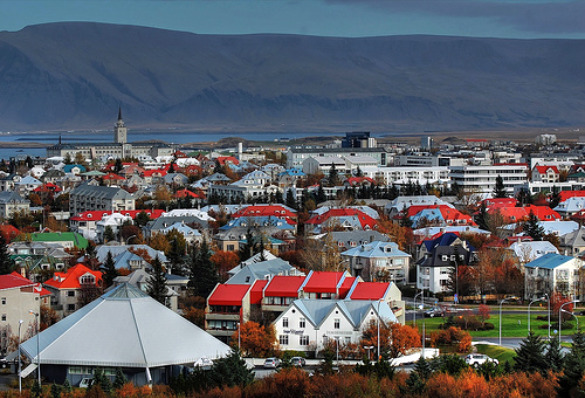
For the capital itself, see the map of Reykjavik. For a sense of how the country breaks down, the regions page covers the north, the Westfjords and the Highlands.
Maps you'll actually use on the road
A Google map is fine for spotting where things are. Once you're driving, you need to know whether the road is open. These are the ones I'd keep open on my phone:
- Umferdin.is is the official road conditions map (road.is sends you there). It shows closures, ice and wind warnings. The traffic information line is 1777.
- Safetravel.is posts current alerts for travelers, including volcanic activity on the Reykjanes peninsula near Grindavík, which erupted nine times between December 2023 and August 2025. The Icelandic Met Office has the latest monitoring. Check it before any trip toward the Blue Lagoon or Keflavík area.
- The Natural Science Institute of Iceland runs a free official map viewer with topographic detail, and a volcanic activity viewer if you want to see where the lava actually went.
When I rented cars in Iceland, the agency handed over a free paper map, and it was more useful than it looked, because it marked which towns had gas stations. Away from the bigger towns, stations can be a long way apart, so fill up when you get the chance. Before you set out, read up on driving in Iceland and driving the Ring Road.
Old maps of Iceland
Mapmakers spent centuries trying to get Iceland's shape right. The National and University Library of Iceland keeps a good online collection of them at Íslandskort.is, and the Natural Science Institute has a historical maps viewer. The oldest detailed picture of the island is on Olaus Magnus's Carta marina, a map of the Nordic lands printed in Venice in 1539, sea monsters and all. Three later maps show how the picture sharpened.
Islandia, 1590

This is the best-known old map of Iceland. It was drawn from a map by Guðbrandur Þorláksson, bishop of Hólar in the north, and published by the Flemish mapmaker Abraham Ortelius in 1590. The bishop's own drawing hasn't survived, but according to Íslandskort.is, the versions printed by Ortelius and Mercator became the model for most maps of Iceland for more than a century. Look for Hekla spewing fire in the south and the whales and sea beasts lined up off the coast, each one marked with a letter.
Insulae Islandiae Delineatio, 1761

Norwegian surveyors working for the Danish king were sent to Iceland under Thomas Knopf, and the Latin title on this map says the work was finished in 1734. The results appeared in Niels Horrebow's book on Iceland in 1752 and then in this Nuremberg edition in 1761. The monsters are gone, and the country is colored by its four old quarters (fjórðungar). The shape is squashed, especially in the Westfjords, but Íslandskort.is notes that the Knopf maps served as a model for many others well into the 19th century.
Uppdráttr Íslands, 1849

This is the first map that looks like the Iceland you'll drive around. Björn Gunnlaugsson, a mathematics teacher, surveyed the whole country for the Icelandic Literary Society between 1831 and 1843. His big four-sheet map, published in Copenhagen, is usually dated 1844, though it wasn't finished until 1848. This smaller one-sheet version followed in 1849. It was the first complete map of Iceland, and other mapmakers built on it for more than half a century. Vatnajökull is there in the southeast, looking much as it does on a modern map.
Fitting Iceland into a bigger trip
Iceland sits between North America and Europe, and a lot of people see it on a stopover. If that's your plan, read how to plan a stopover in Iceland and look at the 10-day itinerary ideas to see how much of the map you can realistically cover.