Alternative Accommodations
Updated · BootsnAll
 Updated September 2026
Hotels, guesthouses and even hostels are expensive in Iceland, and the gap between Iceland and most of Europe hasn't closed since this page was first written. If you're willing to try something less ordinary, you can still save a lot and have a trip you'll remember: a sleeping-bag bunk on a farm, a tent pitched under the midnight sun, or a campervan with the heater on.
One big change first. Sleeping in a campervan wherever you like is no longer allowed. The old version of this page mentioned free wild camping, and plenty of blogs still do. The law changed, and the rules are below.
Sleeping-bag accommodation and farm stays
Outside Reykjavik there are few traditional hotels. Instead you'll find farms, rural guesthouses and small country hotels, and most are well outside town with no bus service, so you'll want your own car. Hey Iceland, the agency that used to be called Icelandic Farm Holidays, books farm stays, guesthouses and cottages and can suggest self-drive routes between them.
Some of these places also offer sleeping-bag accommodation: a bed in a simple room, sometimes a dorm, with shared bathrooms, and you bring your own bedding. It's cheaper than a made-up room, and Hey Iceland lists it as its own category. Ask when you book; not every place advertises it.
Mountain huts
If you're hiking in the highlands, Ferðafélag Íslands (the Iceland Touring Association, known as FÍ) runs huts along routes like the Laugavegur trail. Each one must be booked and paid for in advance, and you bring your own sleeping bag. A space at the Álftavatn hut, which sleeps 72, is listed at 17,000 ISK a night, so "cheap" is relative. Álftavatn also has a campsite you can book instead. Hut opening dates depend on when the highland roads open, which depends on the snow.
Campsites
There are campsites all over Iceland, from town sites next to the local swimming pool to national park sites like the ones at Þingvellir, where camping outside the marked areas isn't allowed. Most campsites only open in summer, so if you're camping in the shoulder season or winter, check each site before you go.
Reykjavík Eco-Campsite
The city campsite, now called the Reykjavík Eco-Campsite, is on Sundlaugavegur in Laugardalur, about 2 km from the center, and it's open all year. The 2026 prices per pitch, with the online discount, are:
- Tent pitch, no electricity, including one adult: 3,555 ISK
- Campervan pitch, no electricity, including one adult: 3,735 ISK
- Campervan pitch with electricity, including one adult: 5,715 ISK
- Each additional adult (13 and over): 3,150 ISK; children 12 and under stay free
- Lodging tax: 400 ISK per camping unit per night
The price includes the guest kitchen, lounge, showers and wifi. Campfires aren't allowed, but there's an outdoor barbecue area. If you have a campervan, note that the campsite says the only wastewater dump station in Reykjavík is at Klettagarðar 14, about five minutes' drive away. Don't empty your tank in public toilets.
Laugardalslaug, one of the city's biggest geothermal pools, is in the same Laugardalur neighborhood. An adult pool visit costs 1,500 ISK, and a hot soak goes a long way after a few nights in a tent.
If you'll be camping a lot, look at the Camping Card (Útilegukortið), a pass that covers stays at a network of campsites around the country. Check which sites are included and whether they're on your route before you buy.
Campervans: the rules changed
A campervan still gives you the most freedom for the least money, especially if you'd otherwise rent a car and pay for rooms. But under the Nature Conservation Act no. 60/2013, which took effect on 15 November 2015, it is illegal to spend the night in a campervan, caravan, tent trailer or similar outside an organized campsite or urban area unless the landowner has given permission. In practice, that means you plan each night around a campsite.
Happy Campers, the company this page recommended back in 2010, is still going, based in Reykjanesbær near the airport. Its vans come equipped for cooking and sleeping, with a winter kit in the cold months. To rent, you need to be at least 18, hold a valid driver's license, and have a credit card with enough limit to cover the self-risk, which is €3,000 with basic collision cover. Happy Campers also publishes a map of every campsite in Iceland, sorted into summer, winter and year-round sites. Daily rates change with the season and the van, so compare current prices directly.
Check whether your van has a toilet or shower before you book. If it doesn't, you'll use campsite facilities and the local pools, which is one of the nicer parts of van life in Iceland. For driving tips, see Safetravel, which has a section on driving a camper, and our pages on driving in Iceland and car rental.
Tent camping outside campsites
The same law is more relaxed about traditional tents, but it still has limits. According to the Environment Agency of Iceland:
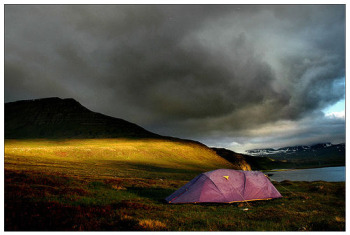
- Along public routes in inhabited areas, you may pitch a traditional tent for one night on uncultivated land, if there's no campsite close by and the landowner hasn't posted signs against it.
- In uninhabited areas, and away from public routes, you may pitch a tent on private or public land unless special rules apply there.
- You need the landowner's permission to camp near homes or farms, to stay more than one night, to pitch more than three tents, or to camp on cultivated land.
- Protected areas have their own rules. Camping is banned outright at places like Dimmuborgir and Dyrhólaey, and only allowed at marked sites at Þingvellir, Mývatn and Skógafoss. Vatnajökull National Park has its own rules too.
If there's a campsite nearby, use it. Take all your rubbish with you.
Couchsurfing
Couchsurfing still operates, and Reykjavik is where you're most likely to find a local to host you and show you around. Outside the capital the pickings are much slimmer, so treat it as a bonus rather than a plan.
FAQ
Can I sleep in my rental car or campervan anywhere in Iceland?
No. Outside organized campsites and urban areas you need the landowner's permission to spend the night in a campervan or similar vehicle. Plan every night around a campsite, and book ahead in July and August.
Is camping in Iceland possible in winter?
Yes, but only at the campsites that stay open, like the Reykjavík Eco-Campsite. Winter means short days, strong wind and storms that close roads, so check the weather forecast and road conditions every day.
Is a campervan cheaper than a car and guesthouses?
Often, especially for two people in summer when rooms are at their priciest. Add up the van, campsite fees of a few thousand ISK per person per night, fuel and the 2026 kilometer fee before you decide, and see our guide on budgeting for Iceland.
>> Prefer a proper bed? See accommodation in Iceland, hostels and vacation rentals.
Photo by eri@si