Keflavik
· Updated · BootsnAll
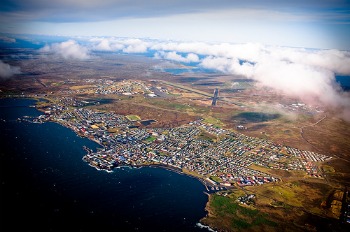 Keflavík is the town next to Iceland's international airport, on the Reykjanes peninsula in the southwest. Most visitors fly in and out of it without ever seeing it. That's a bit of a shame, because if you have an early flight or a spare afternoon, it has a good small museum or two, a long coastal walk and a proper local swimming pool.
The town today
Keflavík merged with neighbouring Njarðvík and Hafnir in 1995 to form the municipality of Reykjanesbær. It's bigger than when I first wrote about it. Keflavík and Njarðvík together had 22,572 residents on 1 January 2026, according to Statistics Iceland. That makes it one of the larger towns in the country outside the capital area.
It's still more of a working town than a tourist town, and that's part of its charm. Hafnargata, the main street through the old town by the harbour, is where most of the cafes and shops are.
A short history
Keflavík grew as a trading post and fishing town from the 16th century. During World War II, US forces built an airfield outside town. After Iceland joined NATO in 1949, the US military stayed on, and Naval Air Station Keflavik became an important base during the Cold War. The United States ended its military presence there on 30 September 2006, and the old base area is now the Ásbrú district.
Keflavík turned out so many musicians in the 1960s and 1970s that Icelanders called it Bítlabærinn, "the Beatle town."
Things to do in Keflavík
Icelandic Museum of Rock 'n' Roll
The Rokksafn Íslands, in the Hljómahöll concert hall, traces Icelandic pop and rock from 1920 to today, Björk included. Admission is free. It's open 9:00 to 18:00 on weekdays and 10:00 to 17:00 at weekends, and the museum says it's a 5-minute drive from the airport.
Víkingaheimar (Viking World)
Víkingaheimar is built around the Íslendingur, a full-size replica Viking ship that sailed from Iceland to New York in 2000. It's open year-round and about 10 minutes from the airport.
Duus Museum and the coastal path
Duus Safnahús, the town's arts and culture centre, holds the town's local history and art museums and the visitor centre for the Reykjanes Geopark. Adult admission is 1,560 ISK as of 2026; children get in free.
Behind the Duus buildings starts the Strandleið coastline trail, a 10 km path along the shore toward Stapi, with signs about local history and wildlife along the way. It's good for a walk, a run or a bike ride. Also in town is Skessan í hellinum, the giantess's cave, a favourite with small kids.
Swimming
The town pool, Sundmiðstöðin, has a 50 m indoor pool, a 25 m outdoor pool, four hot tubs, a steam bath and a cold tub, plus an indoor water park for children called Vatnaveröld. Adult entry is 1,300 ISK as of 2026. It's a cheap, local way to spend a last few hours before a flight. More on pool culture in Reykjavik city pools.
Eating and drinking
Ráin has been open since 1989. It's a big restaurant and bar with views across the bay toward Reykjavik, and it's still going.
For more choice, walk along Hafnargata and see what's open. If you're heading into the capital, see where to eat in Reykjavik.
Should you stay in Keflavík?
If you're catching an early flight, yes. It's a few minutes from the terminal, and you won't have to leave Reykjavik in the middle of the night. If you're in Iceland to see the country, stay in Reykjavik or further out and just pass through. See Reykjavik airport hotels and hotels near the Blue Lagoon.
Getting there and around
- From the airport: Straeto bus 55 and route 89 connect the terminal with Reykjanesbær. It's a one-zone ride, 600 ISK for adults as of 2026. Since January 2026, route 55 stops at Miðstöð and Tjarnarhverfi in town and no longer serves Ásbrú, according to Straeto.
- From Reykjavik: Route 55 runs from Reykjavik to Reykjanesbær for 2,400 ISK. By car it's about 45 minutes on Route 41. See getting between Reykjavik and Keflavik.
The volcanoes next door
The Reykjanes peninsula has erupted repeatedly since 2021, and the Sundhnúkur crater row near Grindavík, on the south side of the peninsula, erupted nine times between December 2023 and August 2025. Roads to Grindavík and the Blue Lagoon have closed at times, and the Icelandic Met Office says magma is still building up. Check safetravel.is for the current situation before you plan a trip down the peninsula. Safetravel also warns of subsidence and sinkholes near the Bridge Between Continents, so stay on marked paths there.
Photo by Zanthia