Transportation
Updated · BootsnAll
 For a small country, Iceland was hard to get around for a long time. The Ring Road (Route 1), which loops the whole island, was only completed in 1974. It's about 1,309 km (813 miles) today. There's no train in Iceland, but between cars, buses, domestic flights and ferries you can reach almost everywhere people live.
This page is the overview. Each section links to a page that goes into more detail.
The short version
To see the country on your own schedule, rent a car. In Reykjavik, walk and take the bus. For long distances when you're short on time, fly. The country buses work, but on many routes they don't run every day, so plan around the timetable.
Getting to Iceland
Almost everyone flies into Keflavik International Airport, about 50 km from Reykjavik. The alternative is the Norröna car ferry from Denmark, which reaches Seydisfjordur in east Iceland for part of the year.
- Flights to Iceland and Iceland's airports
- From the UK and from Ireland
- The Icelandair Stopover, up to 7 nights in Iceland on most transatlantic fares at no extra airfare
- Ferries to Iceland and cruises
From the airport to the city, take the Flybus, Straeto bus 55 (2,400 ISK for adults as of 2026), a taxi or a rental car. Details in getting between Reykjavik and Keflavik.
Getting around Reykjavik
Buses
Reykjavik's city buses, run by Straeto, are clean and easy to use. The old advice about carrying exact change is out of date. A single adult fare is 690 ISK as of January 2026 (it was 280 ISK when I first wrote this). You pay with the Klapp app, a Klapp card, or by tapping a contactless bank card on board. With fare capping, an adult never pays for more than 3 rides a day or 9 a week. Children 11 and under ride free. On Friday and Saturday nights, night buses leave the center at roughly 01:20 to 03:45 for Hafnarfjörður, Breiðholt, Úlfarsárdalur, Norðlingaholt and Mosfellsbær. They only run out of the center, not into it.
The Reykjavik City Card also includes free travel on city buses. Check route maps and times in the Straeto timetables. More in getting around in Reykjavik.
Taxis
Downtown Reykjavik is small enough to walk, so most visitors only need a taxi for the airport or late at night. Taxis are metered. Hreyfill, founded in 1943, runs taxis in Reykjavik and Akureyri, airport transfers and private sightseeing tours. Its fixed price to Keflavik Airport is 22,500 ISK for up to four people as of 2026. Some drivers will happily take you out for the day, which works if you don't want to drive. Tipping isn't expected; see tipping in Iceland.
Buses around the country
The regional buses are owned by the Icelandic Road and Coastal Administration (Vegagerðin), and Straeto provides the timetables, passenger information and some services. The network was reorganised on 1 January 2026. Route 52 from Reykjavik to Vik and Hofn, for example, now runs four days a week.
- Fares are by zone. Reykjavik (Mjodd) to Vik costs 8,400 ISK and Reykjavik to Hofn 17,400 ISK for adults as of 2026. Look up any trip in the Straeto route planner.
- Pay on board with a debit or credit card, cash or a regional bus card. You can't buy the fare in the Klapp app.
- Timetables change by season. Winter timetables on five regional routes started on 24 August 2026.
The bus is fine for getting from town to town. It's not good for sightseeing, since it won't stop at the waterfalls. For that, take a tour: see day tours from Reykjavik, tours in Iceland and bus travel in Iceland.
Route guides: Reykjavik to Vik, to Akureyri, to Husavik, to Isafjordur, to the Snaefellsnes peninsula, to the Golden Circle and to the Blue Lagoon.
Renting a car and driving
The easiest way to see Iceland outside Reykjavik is still to rent a car. It isn't cheap. Rental prices swing a lot by season, so compare a few companies; see car rental in Iceland. If you only need a car for part of your trip, many companies will let you drop it somewhere else, for a fee.
What it costs to run
- Fuel. On 16 September 2026, petrol (95 octane) cost between 222 and 270 ISK a litre across Iceland's stations, and most were near 264 ISK, according to Gasvaktin. Diesel was higher, mostly around 298 ISK. It was about 200 ISK when I first wrote this.
- The kilometre fee. Since 1 January 2026, every vehicle in Iceland pays a fee per kilometre driven, whatever its fuel. For cars up to 3.5 tonnes it's 6.95 ISK per km, and rental cars are included. On the full Ring Road that's roughly 9,100 ISK before any detours. Ask your rental company how they charge it. Cars brought over on the Norröna ferry pay as well, as a fixed fee for stays of up to 30 days (13,900 ISK for 10 days or less, as of 2026).
- Parking fees at popular sights, such as 1,000 ISK a day at Thingvellir.
What driving is like
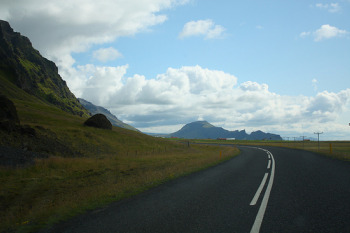
Icelanders drive on the right, and outside Reykjavik there's little traffic. The Ring Road is paved all the way around, but it still has one-lane bridges, blind hills and gravel shoulders. Once you leave it, expect gravel. The mountain roads (F-roads) into the interior need a 4x4, are only open in summer, and many interior roads close completely in winter.
When I first wrote this guide, every rental company handed out a scary-looking safety brochure. Whatever yours gives you, read it. Wind, loose gravel, flooded rivers, whiteouts and livestock are all real. Safetravel's top tips cover the basics: headlights on at all times, stop for oncoming traffic at single-lane bridges, never drive off-road, and don't stop on the road for photos.
Check conditions before you go and during the day:
- umferdin.is: the Road and Coastal Administration's map of road conditions and closures. Its information line is 1777.
- vedur.is: weather forecasts and warnings.
- safetravel.is: travel alerts, including eruptions on the Reykjanes peninsula near Grindavik, which erupted nine times between December 2023 and August 2025 (the Icelandic Met Office has the current status). In an emergency call 112; Safetravel lists 599-0112 as a backup number now that Iceland's 2G and 3G networks are being shut down.
More in driving in Iceland, driving Iceland's Ring Road and the driving photo essay. For roads into the interior, see the Highlands.
Domestic flights
Flying is still the fastest way to cover long distances, and the pilots here are used to wind and snow. Domestic flights leave from Reykjavik's city airport, not Keflavik.
Air Iceland, the airline this page used to recommend (later Air Iceland Connect), became part of Icelandair in 2021. Today:
- Icelandair flies from Reykjavik to Akureyri (about 45 minutes), Egilsstadir (about an hour), Isafjordur (about 40 minutes) and Hofn in the southeast, five times a week. It also flies from Keflavik to Greenland.
- Norlandair flies small planes from Reykjavik to Bildudalur and Gjogur in the Westfjords, and in winter to the Westman Islands. From Akureyri it flies to Grimsey island and to Vopnafjordur and Thorshofn in the northeast. It also flies to Nerlerit Inaat in east Greenland.
If you land at Keflavik and connect to a domestic flight, collect your bags and get yourself to the Reykjavik airport, 50 km away. Icelandair suggests allowing about 90 minutes by bus or 60 minutes by taxi, and you'll need to check in again. For Greenland trips, see how to visit Greenland from Iceland.
Ferries
Ferries link the mainland with Iceland's inhabited islands and cut out some long drives. In summer, book ahead, because car spaces sell out. And if you get seasick, take something before you board; these waters can be rough.
- Herjólfur sails between Landeyjahöfn on the south coast and the Westman Islands. You don't need a 4x4 to reach the port, parking is free, and a bus runs from Mjodd in Reykjavik. Sailings change with the weather, so check the ferry's announcements on the day.
- Baldur crosses Breidafjordur between Stykkisholmur and Brjanslaekur in the Westfjords, stopping at Flatey island. It saves a long drive to the Westfjords.
- Grimsey and Hrisey. In the north, ferries run from Dalvik to Grimsey, on the Arctic Circle, and from Arskogssandur to Hrisey. You can book them through Vegagerðin.
For the far northwest, see how to get to Hornstrandir.
Hitchhiking
Iceland is a very safe country, and people who have hitchhiked here say one of the first few cars often stops. The catch is that in some parts of the country, especially outside summer, you can wait hours between cars. Carry warm, waterproof clothes, water and food, and tell someone where you're going. Safetravel lets you leave a travel plan.
FAQ
Can I get around Iceland without a car?
Yes, but slowly. Between the country buses, domestic flights and tours from Reykjavik you can reach the main towns and sights. The buses on many routes don't run daily, so build your plan around the timetable.
Is there a train in Iceland?
No. Iceland has no passenger railway.
Do I need a 4x4?
Not for the Ring Road or the Golden Circle in summer. You need one for F-roads, which are closed in winter, and a 4x4 with good tires makes winter driving easier. See Iceland in winter.
Photo by dreamo