Driving Iceland’s Ring Road
· Updated · BootsnAll
 A car is one of the best ways to see Iceland, and nearly everyone who visits ends up on the Ring Road, Route 1, at some point. Plenty of people drive the whole loop. It's one of the classic Iceland trips, but it's not as simple as picking up the rental and heading off. Here's what to think about before you go.
How long is the Ring Road?
Route 1 is 1,309 km (813 miles) long, according to the Icelandic Road and Coastal Administration. When I first wrote this page it was a bit longer, but new tunnels and reroutings have trimmed it. The Vaðlaheiðargöng tunnel near Akureyri, for example, cut 16 km and bypasses a mountain road that used to close in winter. The whole road is now paved, and mostly one lane in each direction.
Budget more time than you think
On paper, 1,309 km doesn't sound like much. At 90 km/h you could cover it in about 15 hours, or two long days. In practice, nobody does.
First, you won't average 90. That's the speed limit on paved rural roads; towns and single-lane bridges are 50, and blind hills, sharp bends and mountain passes slow you further. Second, that math leaves no time for meals, fuel, or anything you actually came to see. And trust me, you'll stop constantly for the views.
My rule of thumb:
- 7 days: the minimum for the full loop in summer. You'll drive most days and see the headline stops.
- 10 days: a comfortable pace, with time for a detour to Snæfellsnes or a lazy day at Mývatn. See our 10-day itinerary ideas.
- 14 days: time to add the Westfjords and still slow down.
Distances are deceptive. Two towns might look close on the map, but weather, gravel detours and winding fjord roads can double the time. Check the live road map at umferdin.is, the Road and Coastal Administration's traffic site, or call its traffic line on 1777.
A loop, stop by stop
You can drive it in either direction. Here are the main stretches going counterclockwise from Reykjavik, starting with the south coast:
- South coast: Seljalandsfoss, Skógafoss and the black sand beaches around Vík.
- Southeast: Skaftafell, the Jökulsárlón glacier lagoon, then the harbor town of Höfn.
- East Fjords: the Ring Road now follows the coast between Breiðdalsvík and Egilsstaðir via Reyðarfjörður. It was rerouted in November 2017 away from the Breiðdalsheiði plateau, which often closed in winter. Slower, but prettier and safer.
- Northeast: the empty inland stretch from Egilsstaðir toward Mývatn. Between Mývatn and Skjöldólfsstaðir there are about 113 km with no fuel and no services.
- North: Mývatn, Goðafoss and Akureyri, with an optional detour to Húsavík for whales.
- West: back toward Reykjavik via Borgarnes, with the Snæfellsnes peninsula as a side trip.
The Golden Circle isn't on Route 1, so add a day for it at the start or end.
What it costs to drive
- Kilometer fee: since 1 January 2026, every car pays 6.95 ISK per km. For the full loop that's about 9,000 ISK, and your rental company will bill it (see car rental in Iceland).
- Tunnel toll: Vaðlaheiðargöng, just east of Akureyri, is the one toll tunnel on the loop. A car pays 2,216 ISK per trip as of 2026, online at tunnel.is within 24 hours before or after you drive through. Ask your rental company how it handles this.
- Fuel: petrol cost roughly 235 to 270 ISK a liter at most stations in mid-September 2026, according to Gasvaktin.
- Electric: most towns on the Ring Road now have fast chargers, which makes an EV workable if you plan your stops, especially on the long, empty northeast leg between Mývatn and Egilsstaðir.
For the rest of the trip budget, see how to budget for a trip to Iceland.
Be prepared
Once you're out of the Reykjavik area, fuel stations are few and far between. Top off whenever you can. Carry a good map or offline maps, and know which roads your rental is allowed on. Mountain F-roads need a 4x4, and taking the wrong car onto them breaks your rental terms. It's worth paying for extra insurance too, especially gravel protection.
Book your accommodation ahead. In summer, places along the south coast sell out; in the off-season, many rural guesthouses close. And don't plan on sleeping in the car wherever you like. Overnight stays in campervans and similar vehicles need the landowner's permission outside campsites and towns.
Check that the car has a spare tire, pack warm layers, water and snacks, and keep your phone charged. If something goes wrong in a rural area, you might wait a long time for another car. In an emergency, call 112.
Driving the Ring Road in winter
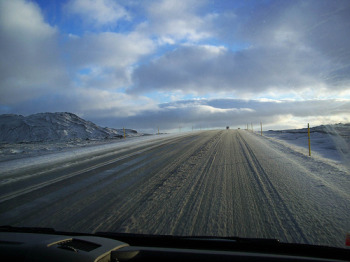
It can be done, and it's beautiful, but take it seriously. Daylight is short, storms close mountain passes, and winter conditions can show up in spring and autumn too. Leave spare days in your plan so a closed road doesn't wreck the trip, and check umferdin.is and the Met Office forecast every morning. If you've never driven on ice, a south coast trip from Reykjavik with a return the same way is the safer choice. See Iceland in winter and our weather page.
FAQ
Can I drive the Ring Road in 5 days?
You can, but you'll spend most of your waking hours in the car. With 5 days, I'd do the south coast as far as Jökulsárlón and back, plus the Golden Circle. Our 5-day itinerary ideas have other plans.
Do I need a 4x4 for the Ring Road?
No. Route 1 is paved all the way, and a regular car is fine in summer. You only need a 4x4 for the F-roads into the highlands, which are open only in summer.
Can I do the Ring Road by bus?
Partly. Public buses cover the south coast to Höfn and the route from Reykjavik to Akureyri, but the East Fjords connections are thin. See bus travel in Iceland.
Photo by Night Owl City